
Metal Stamping and Punching for Production Runs
Progressive and compound dies, from prototype tooling through volume runs, in Dongguan.
What a stamping die costs, and where the break-even sits
Stamping is the cheapest way to make a flat metal part in volume, once the die is paid for. A coil of strip feeds through a press, every stroke cuts and forms, and parts come off the tool at a rate no machining centre can match. The economics flip at a certain quantity: below it, laser cutting or machining is cheaper; above it, stamping wins on both unit price and consistency.
We run progressive dies for high volume and single-station or compound dies for medium runs. The tooling is designed around your drawing — strip layout, pilot holes, bend sequence, and where the part is cut free. Getting the strip layout right is what decides whether the part stays flat and whether the die survives a million strokes.
Typical work is terminals, spring contacts, brackets, shims, reinforcement plates and small covers, usually 0.3 to 4 mm thick, in cold-rolled steel, stainless, aluminium, brass or copper. Tooling and unit price are quoted as separate lines, so you can see exactly what you are paying for and where the break-even sits.
Stamping wins where the part is flat or simply formed and the volume runs into the thousands. It loses where the geometry needs bends in several directions, where the part is thick relative to its size, or where the annual quantity never repays the die. In those cases laser cutting plus forming, or a fabricated weldment, is the cheaper route. We quote both routes when the quantity sits near the break-even, so the choice is made on two numbers rather than on a preference.
The break-even is not a fixed number either. A simple bracket in 1.5 mm steel might repay its die in 3,000 pieces; a progressive die with eight stations needs far more. Send the annual quantity with the drawing and we will tell you which side of the line you are on.
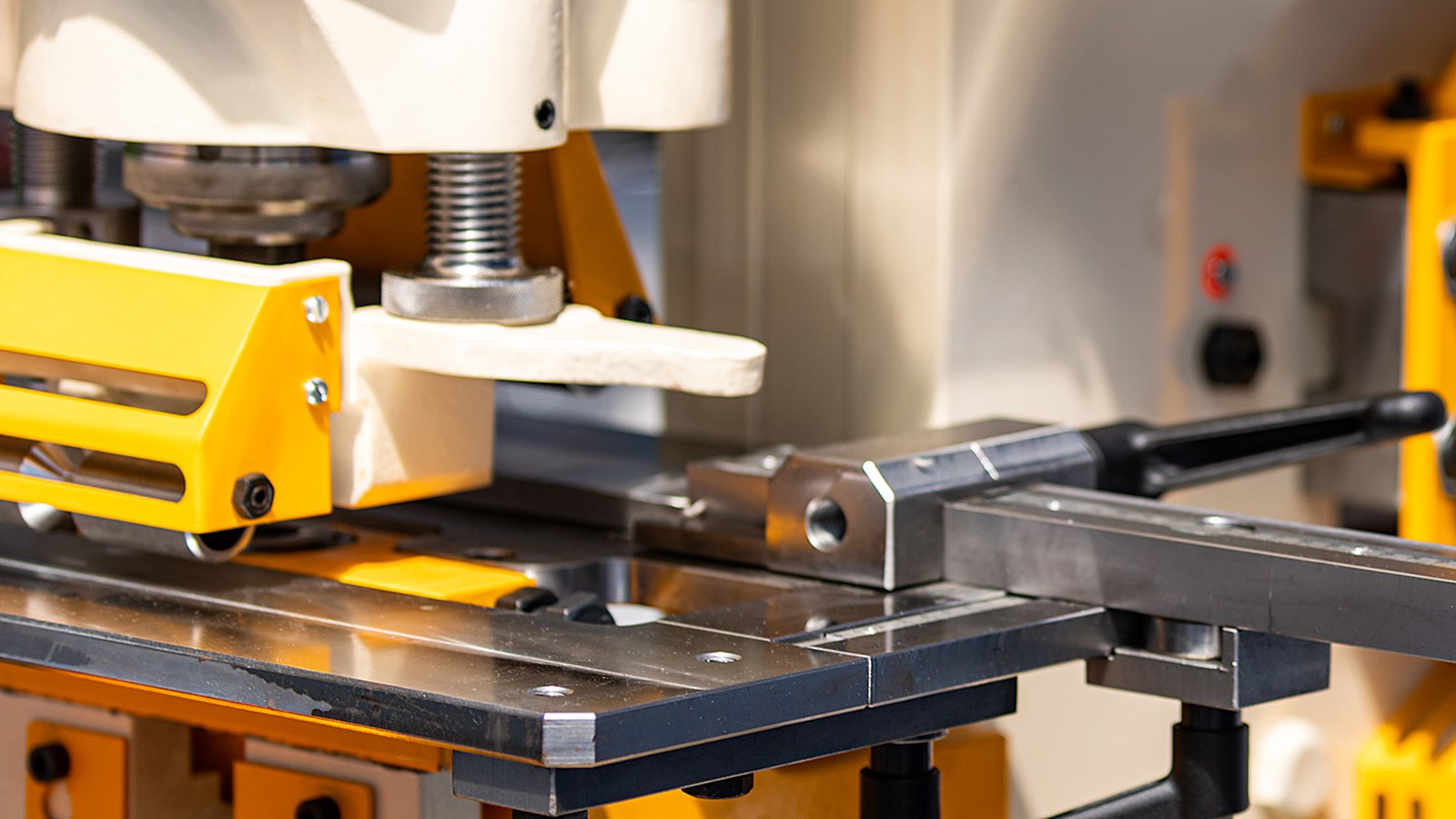
Six things that keep a stamped part flat
- Tooling cost stated separately — You see the die cost and the unit price as two lines, so you can calculate the break-even quantity yourself instead of guessing.
- Progressive or single-station, whichever fits your volume — We do not sell you a progressive die for 500 pieces, and we do not run 200,000 pieces on a hand-fed tool.
- Strip layout decided before the die is cut — Pilot position, bend sequence and material utilisation are fixed on paper first. A poor strip layout shows up later as twist and camber in the finished part.
- First article and in-process checks — First parts are measured against the drawing, and critical dimensions are checked on a sample across the run, not only on the first piece.
- Stamping plus secondary operations — Tapping, welding, deburring, plating and assembly are sequenced with the stamping, so you are not left holding a box of flat parts.
- Inspected by our own QC team — Every batch is checked before packing, including work scheduled at our affiliated plants.
Press and die capacity
| Parameter | Range |
|---|---|
| Press tonnage | 10T – 125T |
| Material thickness | 0.1 mm on thin-gauge work; 0.3 – 4 mm for general press work |
| Strip width | up to 400 mm |
| Progressive dies | up to 4 stations; compound and single-station dies for heavier sections |
| Stamping tolerance | ±0.05 mm typical on stamped features; ±0.10 mm general |
| Minimum run | 5,000 pieces; smaller batches quoted on single-station tooling |
| Lead time | 20–40 days after drawing approval; tooling lead time quoted separately |
Strip materials and the finishes they take
Cold-rolled steel (SPCC, SPHC), hot-rolled pickled and oiled, stainless 301 / 304 / 316L, aluminium 5052 / 6061, brass H62 and H65, copper, phosphor bronze and beryllium copper for spring contacts.
Finish is applied after stamping: zinc plating, nickel plating, tin plating, powder coating, or passivation for stainless. Where the part is a contact, the plating thickness is specified rather than left to the default.
Material grade changes die life, not just the price. The same part in 301 stainless will wear a die several times faster than in SPCC, and high-strength steel can spring back enough to need an over-bend built into the tool. If the drawing names a grade we have not run before, we say so at review rather than discovering it after 50,000 strokes.
Parts we stamp most often
Terminals and contacts · Spring clips and spring contacts · Mounting brackets and L-plates
Shims, washers and spacers · Reinforcement and gusset plates · EMI shields and small covers
Coil set and camber are not the same thing. Strip arrives with a memory of the coil it was wound from, so a long part can come out with a slight curve even when every dimension is in tolerance. It is corrected with a straightener or a stress-relief step, not by adjusting the die with a hammer. If the part is longer than about 300 mm, say so at quoting stage, because the strip handling and the straightening change.
The same applies to a part with a long narrow leg: the leg twists as it strips from the die. The twist is invisible on a 2D drawing and obvious in an assembly jig.
Three drawing details that decide the die
Spring properties depend on grain direction.
If the part is a spring or a contact, the angle between the bend line and the rolling direction decides whether it holds its shape after forming. We set the strip layout with that in mind. If you have a spring-rate requirement, send it with the drawing.
Bend radius against thickness.
A bend tighter than the material thickness will crack on the outside of the radius, especially in stainless and high-strength steel. If the drawing shows a sharp corner, we will propose a radius and explain what it costs to keep the corner sharp.
The burr side matters at assembly.
Punched parts carry a burr on one face. If the part sits against a surface or slides in a slot, tell us which face must be burr-free — the die can be set so the burr ends up on the hidden side.
From drawing to first article, in six steps
How stamping runs are checked
- Strip material is verified against the grade you specify on receipt.
- The first article is measured and approved before the run continues.
- Every batch is checked by our own QC team before packing.
What to put on the drawing for a stamping quote
2D drawing with tolerances · material grade and thickness · annual volume and batch size
which face must be burr-free · surface finish or plating · packing and labeling rules
Questions buyers ask about stamping
Is the tooling mine?
Yes. Die cost is charged once and the tool is kept for your part only. We can ship it to you if production moves.
What quantity makes stamping cheaper than laser cutting?
It depends on part complexity, but the die usually starts paying for itself somewhere in the low thousands of pieces. Send the quantities and we will quote both routes so you can compare.
Can you do small batches?
Yes, on single-station or compound tooling, which costs less than a progressive die. The unit price will be higher than a volume run.
Do you do bending, tapping and welding as well?
Yes. Secondary operations are sequenced with the stamping, not quoted by a third party.
What tolerance can you hold?
±0.05 mm on stamped features, depending on material and thickness. Critical dimensions are checked on a sample across the run.
How fast is a quote?
Within one business day, with tooling and unit price on separate lines so you can judge the break-even yourself.
Send the drawing and the annual quantity. We will quote the die and the unit price, and tell you where the break-even sits.