
Aluminum and Zinc Die Casting for OEM Components
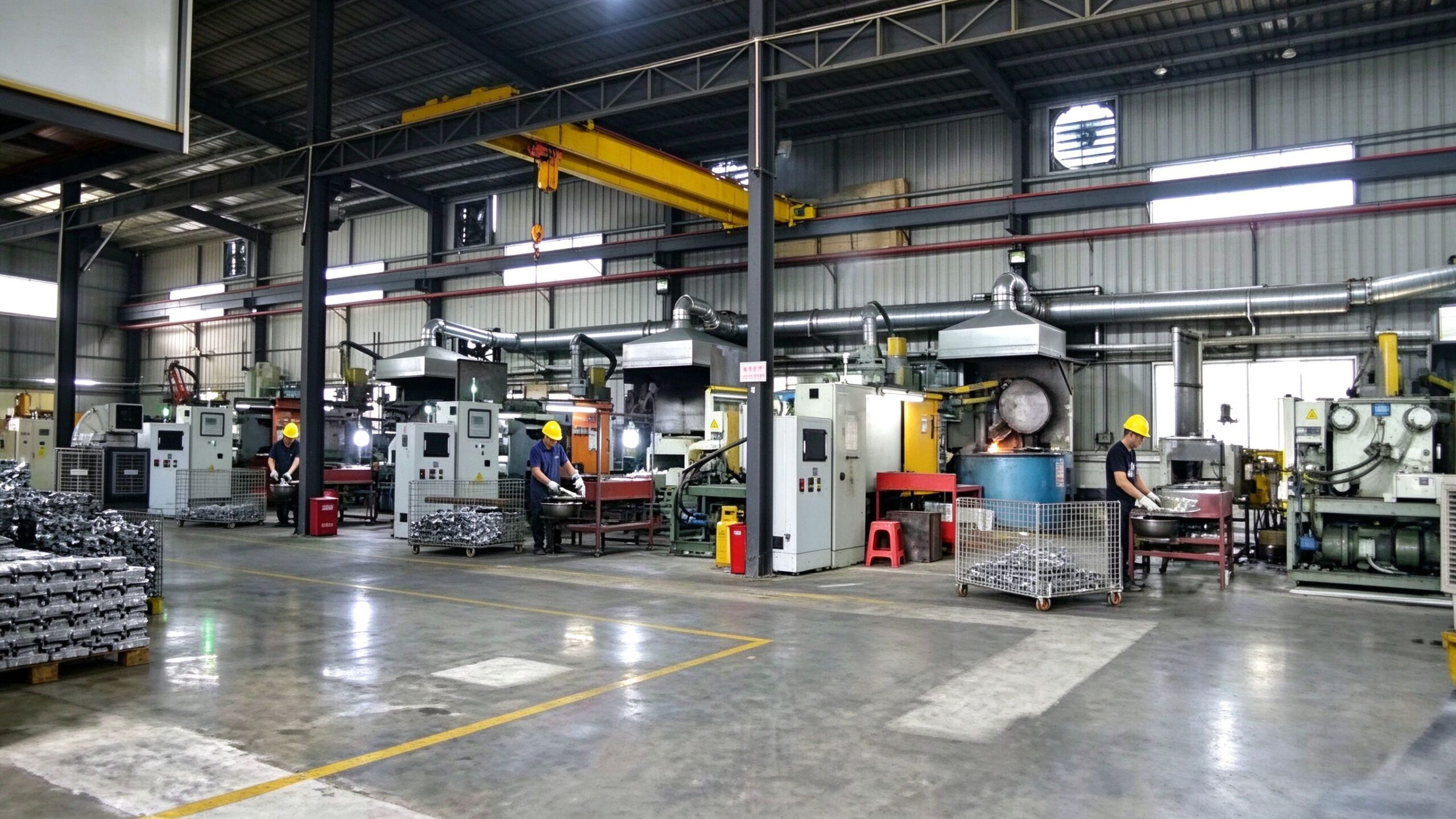
Cast at our affiliated plant in Dongguan, then machined, finished and inspected by our own QC team.
How die casting works and when it fits
Die casting gives you a part that is close to final shape in one shot. Aluminium or zinc is injected into a hardened steel die, the shot solidifies in seconds, and the part comes out with its walls, bosses and mounting holes already formed. Everything after that — trimming, machining the tight features, tapping and finishing — is where most projects lose their delivery date.
We run die casting through our affiliated plant and keep the rest of the work in our own workshop. The die is reviewed before it is cut, the first shots are measured against your drawing, and the finished parts are checked by our own QC team before they are packed. That gives you one quotation, one schedule and one inspection standard for the whole part, instead of a casting price plus three subcontractors to chase.
Typical parts are motor end covers, gearbox and pump housings, mounting brackets, handles and decorative trim. Volumes usually start in the low thousands, because the die has to be paid for. Below that quantity we will tell you honestly whether stamping or machining is the cheaper route for your part.
Die casting wins on volume plus shape. Where a part needs ribs, bosses, draft and thousands of identical units, casting is cheaper than machining each one from solid and more rigid than welding an assembly. Where it loses is low volume, very large parts, or walls thinner than the process can fill. In those cases we say so at quoting stage and propose stamping, machining or a fabricated weldment, instead of quoting a die you will never amortise.
A rough rule from our own quoting: below about 1,500 pieces a year, machining or fabrication usually wins; above 5,000, casting almost always does; between the two it depends on how much machining the casting saves. If your part sits in the middle, send the drawing and we will quote both routes.
Six reasons buyers stay with us
- Tooling reviewed before the die is cut — Draft angles, wall thickness, gate position and ejector marks are checked against your print first. A one-degree draft error caught on paper saves a re-cut later.
- Casting, machining and finishing on one schedule — Trim, CNC, tapping and coating are sequenced with the casting, so parts arrive finished instead of arriving as three half-done batches.
- First article signed off before the run — First shots are measured against the drawing and, where you have one, against your golden sample. The run only continues after that approval.
- Repeatable on reorder — The die stays dedicated to your part and the process parameters are recorded, so a reorder two years later runs on the same settings.
- Machined features measured, not assumed — Cast tolerances and machined tolerances are not the same thing. We machine the critical features and check them on the bench rather than hoping the casting holds them.
- Inspected by our own QC team — Every batch is checked before packing, including work scheduled at our affiliated plant.
Capacity at a glance
| Parameter | Range |
|---|---|
| Material | Aluminium ADC12 / A380; zinc alloy Zamak 3 and 5 |
| Clamping force | 160T – 1,600T cold chamber, quoted per part geometry |
| Max part weight | Aluminium up to 3 kg; zinc up to 1.5 kg |
| As-cast tolerance | CT7 per GB/T 6414 (ISO 8062) |
| Machined tolerance | ±0.05 mm on critical features, checked on the bench |
| Die life | 100,000 shots on aluminium, up to 1,000,000 on zinc, with scheduled polishing |
| Minimum run | 1,000 pieces; prototype quantities quoted separately |
| Lead time | 20–40 days after drawing and die approval |
Alloys and finishes we run
Aluminium ADC12 and A380 for structural and enclosure parts, chosen for fluidity and pressure tightness. Zinc Zamak 3 and 5 where thin walls, sharp detail or a chrome-quality surface matter more than weight.
Finishing is planned with the casting, not after it: vibratory deburring, shot blasting, powder coating, painting, anodizing for aluminium, and zinc or nickel plating for zinc parts.
Where a part has both cast and machined surfaces, we mark which is which on the drawing before quoting. A cast face and a machined face look identical in a photograph and behave completely differently in assembly: one holds a seal, the other does not. Marking them at review also tells us how much stock to leave, which is the difference between one operation and three.
Parts we cast most often
Motor and gearbox end covers · Pump and valve housings · Mounting brackets and base plates.
Handles and levers · Decorative trim and bezels · Sensor and connector bodies.
Ejector marks land on a face somebody has to look at. Every casting needs ejector pins to push it out of the die, and each pin leaves a witness mark and a faint ring. If both faces are cosmetic, tell us early — the die can be laid out so the pins land on an internal rib or a hidden step. Moving them after the die exists means welding and re-cutting, which costs more than the whole design review did.
The same applies to the gate. It leaves a trimmed scar and a small heat-affected patch, so it belongs on a face that will be machined, painted or hidden. None of this is visible on a 3D model, which is exactly why it gets missed.
Three decisions made before the die is cut
Wall thickness is decided early.
Cast walls below about 1 mm get expensive fast: the die needs more draft, the scrap rate climbs, and porosity starts showing up after machining. If the part can carry 1.5–2.5 mm walls, the unit price drops and the surface comes out cleaner. We flag this at drawing review, before the die exists.
Machining allowance has to be left on the casting.
Any face that must be flat, sealed or carry a thread needs stock on it. Tell us which features will be machined and we leave the allowance in the casting, instead of adding a second operation later.
Porosity and sealing.
If the part holds fluid or gas, say so at quoting stage. Pressure tightness is a casting process decision — shot profile, die venting, sometimes vacuum assist — and it cannot be inspected into the part at the end.
From drawing to delivery, in six steps
How each batch is checked
- The die is trial-shot and the first article measured before production starts.
- Critical machined features are checked on the bench, not assumed from the casting.
- Every batch is inspected by our own QC team before packing — including work at our affiliated plant.
What to send with your RFQ
2D drawing with tolerances and the 3D model · alloy and surface finish · the features that must be machined
annual volume and batch size · pressure-tightness or drop-test requirement · packing and labeling rules.
Questions buyers ask about die casting
Who owns the die?
You do. Tooling is paid for by you and kept for your part only. If you move production elsewhere, we can ship the die to you.
How long does tooling take?
It is quoted on a separate line from production lead time, because it depends on die complexity and the number of trial rounds. You will see both dates in the quotation.
Can you machine and finish the castings?
Yes. Trim, CNC machining, tapping, anodizing, powder coating and plating are all sequenced with the casting.
Which alloy should I use?
ADC12 or A380 for most structural aluminium parts; Zamak 3 or 5 for thin walls and detailed zinc parts. Send the drawing and we will say which fits.
What about porosity?
If the part must be pressure-tight, tell us at quoting stage. It is controlled in the casting process, not inspected in afterwards.
What is the minimum order?
Production runs start at 1000 pieces because the die has to be amortised. Prototype quantities are quoted separately.
Send the 3D model and the drawing. We will come back with alloy, draft angles, tooling cost and lead time — usually within one business day.