
Injection Molding for Plastic and Insert-Molded Parts
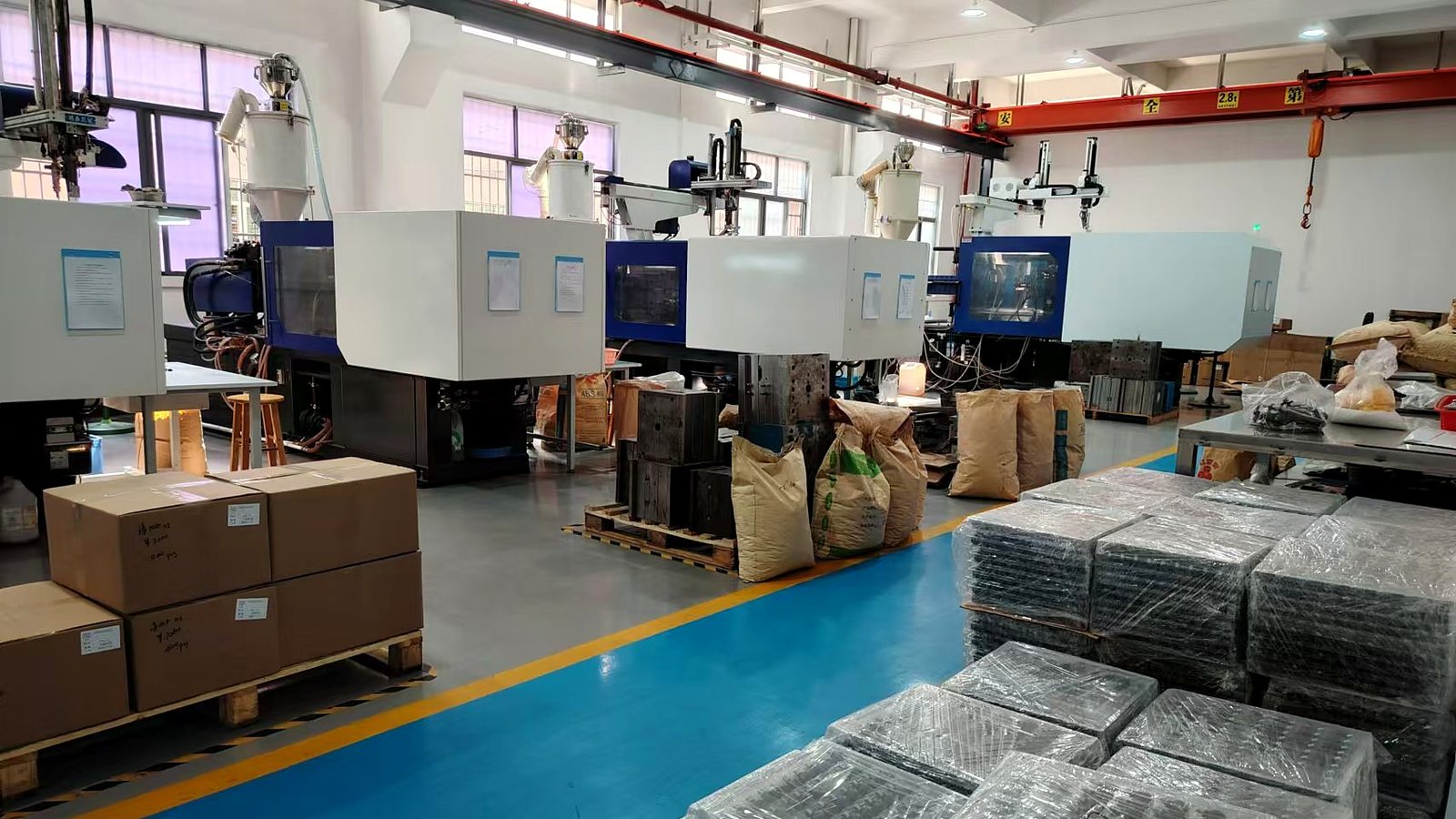
Eighteen presses from 160T to 1200T, running engineering plastics alongside our metal parts.
What molding suits, and what it does not
Injection molding is the other half of most hardware assemblies: the housing around a metal bracket, the panel in front of a control board, the handle that has to feel right in the hand. Resin is melted, injected into a steel mold under pressure, and the part comes out with its shape, texture and colour already set.
We run eighteen presses from 160T to 1200T, which covers everything from a small connector body to a large appliance panel. Where a part needs metal inside it, we mold the insert in place so the plastic shrinks onto the metal, instead of gluing or screwing it in afterwards — and instead of a failure mode that appears in the field two years later.
Typical work is enclosures, face panels, buttons, knobs, cable glands and insert-molded components. As with die casting, the mold is the decision that sets the unit price, so the first conversation is about part geometry and annual volume, not about the machine.
Molding wins where the part is plastic, the geometry is complex and the volume justifies a mold. It loses against machining or thermoforming at low volume, and against die casting where the part has to be metal for strength or heat. The numbers that actually move the unit price are wall thickness and cycle time: a design review that removes two seconds from the cycle is worth more than a discount on resin.
A part that needs 500 pieces a year does not need a hardened steel mold. In that case we quote an aluminium or pre-hardened tool, and tell you at what volume it stops making sense.
Six decisions made before the mold steel is cut
- Mold flow reviewed before the steel is cut — Gate position, wall thickness and cooling layout are checked first. Warp and weld lines are designed out, not polished out afterwards.
- 160T to 1200T in one plant — Small precise parts and large panels run under the same roof, so a family of parts can share one supplier and one schedule.
- Insert molding in the same cycle — Threaded inserts, bushes and metal brackets are molded in place, which removes a gluing or press-fit step and the failure mode that goes with it.
- Colour and texture matched to a sample — Masterbatch matched to your Pantone or physical sample, with texture specified on the mold, so the second order looks like the first.
- Trial shots you can actually assemble — Samples arrive with a dimensional report, so your engineering team tests the real part instead of a promise.
- Inspected by our own QC team — Every batch is checked before packing against the drawing and the approved sample.
Press and mold capacity
| Parameter | Range |
|---|---|
| Clamping force | 18 presses, 160T – 1200T |
| Max shot weight | 5,000 g (PS) on the 1200T press |
| Max mold size | 1,000 × 900 mm; mold height 400 – 1,000 mm |
| Materials | ABS, PC, PC/ABS, PA6 / PA66, POM, PBT, PP, TPU |
| Molding tolerance | ±0.10 mm typical |
| Mold lead time | 4 – 8 weeks from approved DFM; T1 samples 1 – 2 weeks after first shot |
| Minimum run | 5,000 pieces; 500 pieces from an existing mold |
| Lead time | 20–40 days after drawing approval |
Resins we run and the finishes they take
Engineering plastics for structural parts (ABS, PC, PC/ABS, PA6, PA66, POM, PBT, and glass-filled grades), commodity resins for covers and non-structural parts (PP, HDPE, PS), and soft-touch grades (TPU, TPE) for grips and seals.
Secondary finishing is planned with the mold: ultrasonic welding, pad printing, laser marking, painting, and assembly with metal components. Where a marking is required on every part, the fixture is agreed at sample stage so position does not drift between batches.
Colour is a resin decision rather than a paint decision whenever the part can be molded in colour. Molding in colour removes a painting step, a curing step and a whole class of scratches that appear in transit. The limit is that some colours — metallics, deep reds, high-gloss blacks — do not reproduce well in resin, and there painting is still the right answer.
Parts we mold most often
Enclosures and housings · Face panels and bezels · Buttons, knobs and caps
Cable glands and strain reliefs · Insert-molded brackets and bushes · Seals and grips in TPE / TPU
Gates leave a mark, and where the gate sits decides the part. A gate on a visible face leaves a witness that must be trimmed and, on textured parts, blended by hand. We place the gate on a hidden face or an internal rib. Where that is impossible, we agree with you which face takes the mark before steel is cut — a five-minute conversation at design review and a very expensive one afterwards.
The same logic applies to ejector pins and to the parting line. On a part with a soft-touch or high-gloss finish all three are visible, and all three are decided by the mold layout rather than by the operator.
Three wall and draft decisions that set the mold
Wall thickness should be as uniform as possible.
A thick section next to a thin one cools at a different rate and pulls the part out of shape. Where a thick section cannot be avoided, we core it out or accept a sink mark on a hidden face — decided at review, not discovered at trial.
Draft and texture go together.
Every textured surface needs roughly one degree of draft per 0.025 mm of texture depth. A deep texture on a zero-draft wall will drag and scuff on ejection, and no amount of polishing fixes it afterwards.
Shrinkage is not a single number.
Glass-filled grades shrink differently in the flow and cross-flow directions. If the drawing carries tight hole positions, we agree which dimensions are critical before cutting steel, because mold correction after trial is possible but expensive.
From drawing to first shot, in six steps
How molded batches are checked
- Resin is verified against the grade and colour you specify on receipt.
- Trial samples and the first production parts are measured against the drawing before the run continues.
- Every batch is checked by our own QC team before packing.
What to send for a molding quote
3D model (STEP / IGES) and 2D drawing · resin grade, colour and texture · inserts or metal parts to be molded in
annual volume and batch size · printing or painting requirement · packing and labeling rules
Questions buyers ask about injection molding
Who owns the mold?
You do. The mold is paid for once and kept for your part only. We can ship it to you if you move production.
How long does tooling take?
Mold making usually takes four to six weeks from approved DFM to trial shots,depending on cavity count and steel grade. Trial shots and one round of corrections are included in the mold quote; further changes caused by a drawing revision are quoted separately.
Can you mold metal inserts in place?
Yes. Threaded inserts, bushes, pins and brackets can be molded in, which removes a press-fit or gluing step.
What tolerance can you hold?
±0.10 mm typical on molded features. Critical dimensions are agreed before the mold is cut, because they decide where the steel gets corrected.
Can you match a colour?
Yes, against a Pantone reference or a physical sample. Texture is specified on the mold as an MT or VDI grade.
What is the minimum order?
Production runs start at 5000 pieces; prototype quantities are quoted separately.
Send the 3D model and say roughly how many parts a year you need. We will come back with mold cost, unit price, and the wall thickness or draft changes that would make it cheaper.